
Faceless business videos replace on-camera presence with screen recordings, voiceover, animated explainers, stock footage, and text-driven formats. Owners avoid the camera entirely while still publishing consistent, professional video content. Helium Digital builds and runs complete AI marketing stacks, including video production, for high-touch service businesses across North America.
Key Takeaways
- Faceless business videos replace on-camera presence with screen recordings, voiceover, animated explainers, stock footage, and text-driven formats.
- Video marketing without being on camera solves the problem of owners avoiding video because being filmed feels uncomfortable.
- High-touch service industries gain the most from faceless video for business, including real estate agents, home service contractors, and medical practices.
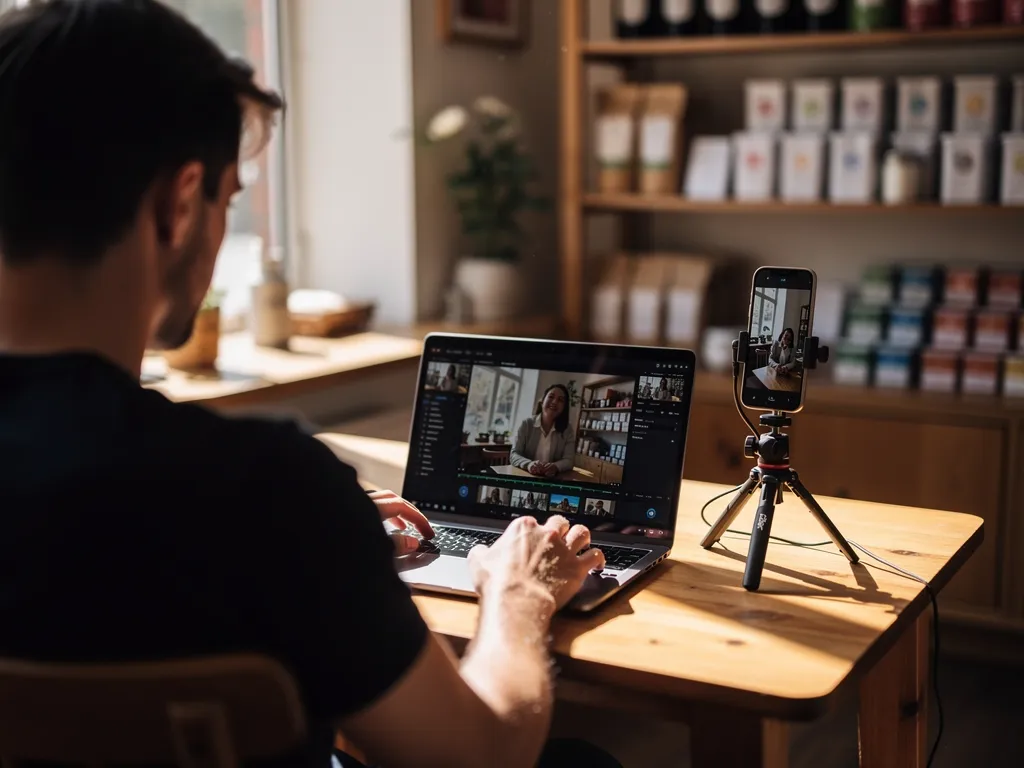
- A smartphone and natural light cover the essentials for creating faceless business videos. Tripods help for stability.
Why make videos if you hate being on camera?
Video remains one of the most effective ways to promote a service business. Many owners avoid it entirely because being filmed feels uncomfortable. The camera introduces a barrier that stops capable professionals from reaching new clients. That hesitation costs you visibility and trust in markets where competitors are already publishing.
Video marketing without being on camera solves this problem directly. You can create powerful, personality-packed videos without ever putting your face on screen. The content does the work. Your expertise, your results, and your process become the focus instead of your on-camera presence.
What types of businesses benefit most from faceless video?
High-touch service industries gain the most from faceless video for business. Real estate agents, home service contractors, medical practices, and legal professionals all rely on trust and demonstrated competence. A video showing a finished renovation, a walkthrough of a dental procedure room, or a document-review workflow builds credibility faster than text alone. The viewer sees proof without needing to see the person behind it.
Can you use AI avatars instead of appearing on camera?
AI avatar video for business offers another path for owners who want a presenter without being the presenter. A digital spokesperson delivers your script while you stay behind the scenes. This approach suits explainer content, FAQ videos, and service overviews where consistency and clarity matter more than personal charisma. The avatar handles delivery. You supply the message. Synthetic avatars require no filming of the owner at all.
Short videos for small business perform well across platforms because they match how prospects browse. A 60-second before-and-after clip, a tool demonstration, or a client-result highlight communicates value immediately. These formats require no on-camera talent and minimal production time.
The range of video ideas for service business extends far beyond talking-head interviews. Screen recordings of your booking process, time-lapse footage of a job site, and animated service comparisons all qualify. Each format removes the camera-shyness barrier while keeping your brand visible where buyers search.
Helium Digital builds and runs a complete marketing stack that includes video production for service businesses. One team handles search, ads, video, and direct mail so you get a unified system instead of disconnected tools. The video component fits into a larger engine designed to generate leads without requiring you to become an on-camera personality.
What can you film instead of your face?
Your product, your process, your location, finished work, or a screen recording can carry a video on its own. Each of these subjects answers one customer question, and that answer is the reason to press record. A service business owner who skips the on-camera introduction loses nothing in reach. The work itself supplies the visual proof.
Video marketing without being on camera starts with what already sits in front of you. Film the job site before and after. Record the counter, the waiting room, or the truck bay. Capture a screen as you walk a client through a quote. None of these shots require a presenter, and each one shows a prospect what to expect.
What formats work best for faceless video for business?
Short clips, clean visuals, simple graphics, and quick explanations perform well on today's platforms. Sprout Social reports that video continues to outperform text-only content, which makes the format choice straightforward. Keep the frame clean and the explanation brief. A faceless video for business does not need a scripted host to hold attention.
Do you need an AI avatar to avoid the camera?
No. An ai avatar video for business is one option, not a requirement. The stronger starting point is footage of real work, because it carries proof a synthetic presenter cannot. Reserve avatar tools for announcements and routine updates where no product or process exists to film.
Short videos for small business succeed on repetition, not production budget. Build a running list of video ideas for service business that match your daily routine:
- A finished installation or repair
- A walkthrough of your location
- A screen recording of a common customer question
- A close-up of the materials or tools you use
Helium Digital builds and runs video systems for high-touch service businesses across North America. The camera stays pointed at the work.
How do you make a faceless video for business?
Creating a faceless video for business requires no studio, no presenter, and no on-camera time. The raw material already sits on your phone: the work, the product, the place, and the result. You can produce one short, useful video this week from those assets alone.
The simplest format is a job photo slideshow. Capture before, during, and after shots of a project, then sequence them with a voice-over or text overlay. This format shows the work without showing the owner. Decorators, print shop operators, and service professionals across trades use slideshows to demonstrate quality without stepping in front of a lens.
Screen recordings offer another direct path. Record your screen while walking through a process, explaining a common client question, or demonstrating a tool. Add a voice-over and you have a teaching asset that builds authority. No camera. No staging. Just expertise made visible.
What equipment do you need to start?
A smartphone and natural light cover the essentials. Tripods help with stability for product or workspace shots, but handheld footage works for quick social content. The barrier to entry is lower than most business owners assume.
How long should a faceless business video be?
Platform dictates length. Short videos for small business perform best on Instagram Reels and TikTok, where brevity holds attention. YouTube and website embeds support two to five minutes for tutorials or process walkthroughs. Start short and extend only when the material demands it.
For service businesses ready to scale production, Helium Digital builds AI avatar video for business through its ListingVidz brand. ListingVidz produces AI-driven video content designed for real estate and service businesses, removing the production bottleneck entirely. The output is consistent, professional, and never requires the owner on camera.
Video ideas for service business that work without a face include tool demonstrations, workspace tours, client result reveals, and FAQ answers delivered via screen recording. Each format keeps the focus on the outcome, not the person delivering it. That shift makes video marketing without being on camera a repeatable system rather than a one-off experiment.
Can an AI avatar video for business work for you?
An AI avatar video for business eliminates the single biggest barrier to video marketing: appearing on camera. A synthetic avatar requires no recording of your face or voice at all, while a custom personal avatar needs just one initial setup recording to create a digital presenter that delivers your message without requiring you to film every take. The result is consistent, professional video content that scales across your marketing channels while you stay behind the scenes.
Faceless video for business succeeds because it shifts attention to what matters. These formats focus purely on content, allowing for creativity and connection without an on-screen presence. Service business owners who avoid the camera still build trust through demonstration, explanation, and results footage. The work itself becomes the star.
How does an AI avatar compare to traditional on-camera video?
A custom personal AI avatar requires one initial recording session. Traditional video demands you appear for every new piece of content. The avatar delivers scripts you write later, while on-camera video locks you into whatever you said during filming. Both formats build recognition, but the avatar removes the recurring discomfort that stops most owners from starting.
What types of service businesses benefit most from faceless video?
Any business where the result speaks louder than the presenter benefits. Real estate agents showcase properties. Home service contractors document transformations. Medical practices explain procedures. Legal and financial professionals deliver educational content. The product, the place, and the result already live on your phone. Those assets form the foundation of video ideas for service business that never require your face.
Short videos for small business perform best when they demonstrate expertise rather than personality. A 60-second walkthrough of a completed project, a time-lapse of a service in progress, or an avatar-narrated explanation of a complex process all outperform talking-head footage. One accountable partner builds and runs the full marketing stack, including video production, so you receive finished content without managing another vendor. An effective AI marketing strategy integrates these video formats into a system that generates leads while you focus on delivering the service itself.
Where should you post short videos for small business?
Short videos for small business perform best on platforms that reward simplicity over high production value. YouTube Shorts, Instagram Reels, and TikTok are the three non-negotiable destinations for service business owners who want visibility without appearing on camera.
These platforms share one common standard: short clips, clean visuals, simple graphics, and quick explanations outperform polished ads every time. The algorithm does not care about your lighting setup. It rewards content that holds attention and answers a question.
Which platform gives the fastest results for faceless content?
TikTok delivers the fastest organic reach for faceless video for business content. A well-timed service tip or behind-the-scenes clip can reach thousands of viewers within hours. Instagram Reels, by contrast, builds slower but converts better for local service businesses because your existing followers and location tags add trust signals. YouTube Shorts offers the longest shelf life; a video idea for service business content posted there continues generating views for months.
Do you need to post everywhere at once?
No. Start with one platform and master it before expanding. Most service business owners see the strongest early returns from Instagram Reels because the platform already connects local audiences. Once one channel produces consistent engagement, repurpose that content across the others. A single short videos for small business strategy, executed on one platform first, consistently outperforms a scattered presence on three.
FAQ
What are faceless business videos?
Faceless business videos replace on-camera presence with screen recordings, voiceover, animated explainers, stock footage, and text-driven formats. Helium Digital builds and runs complete AI marketing stacks, including video production, for high-touch service businesses.
Which industries gain the most from faceless video?
High-touch service industries gain the most, including real estate agents, home service contractors, medical practices, and legal professionals. These businesses rely on trust and demonstrated competence, and video builds credibility faster than text alone.
What equipment do I need to create faceless business videos?
A smartphone and natural light cover the essentials for creating faceless business videos. Tripods help for stability.
Conclusion
The decision to start producing video content does not require appearing on camera. A smartphone, natural light, and a focus on demonstrating results provide the foundation. Service business owners who adopt faceless formats shift attention to the work itself, building trust through proof rather than personality. Begin with one platform, master it, and expand from there. The barrier to entry is lower than most assume, and the system scales once established.